Keeping a Ryzen 7600X cool in the Jonsbo C6 with the IS-55 and Eco Mode
The CPU cooler that fits a Ryzen 7600X or 7700X in the Jonsbo C6, and the speed 65 W Eco Mode costs. Published benchmarks, two charts and the exact settings.
A builder who owns both the ITX and micro-ATX versions of the Jonsbo C6 asked us which CPU cooler keeps a Ryzen 7700X cool in a case that small.
We told them the ID-Cooling IS-55, with AMD's 65 W Eco Mode turned on. In published tests, Eco Mode cost a single-digit percentage of multi-core speed and close to nothing in games.
Raster Zero uses this exact setup: a Ryzen 5 7600X under an IS-55 in a Jonsbo C6, and we recommend 65 W Eco Mode for it. The numbers below come from published reviews, linked where they appear.
The 75 mm limit
The Jonsbo C6 is about 15.9 liters, a small desktop case. Jonsbo lists a CPU cooler limit of 75 mm, which rules out tower coolers.
The ID-Cooling IS-55 is 57 mm tall and carries a 120 mm slim fan: 15 mm thick, 500 to 2,000 RPM, rated at 31.2 dBA. That leaves a gap above the fan for air.
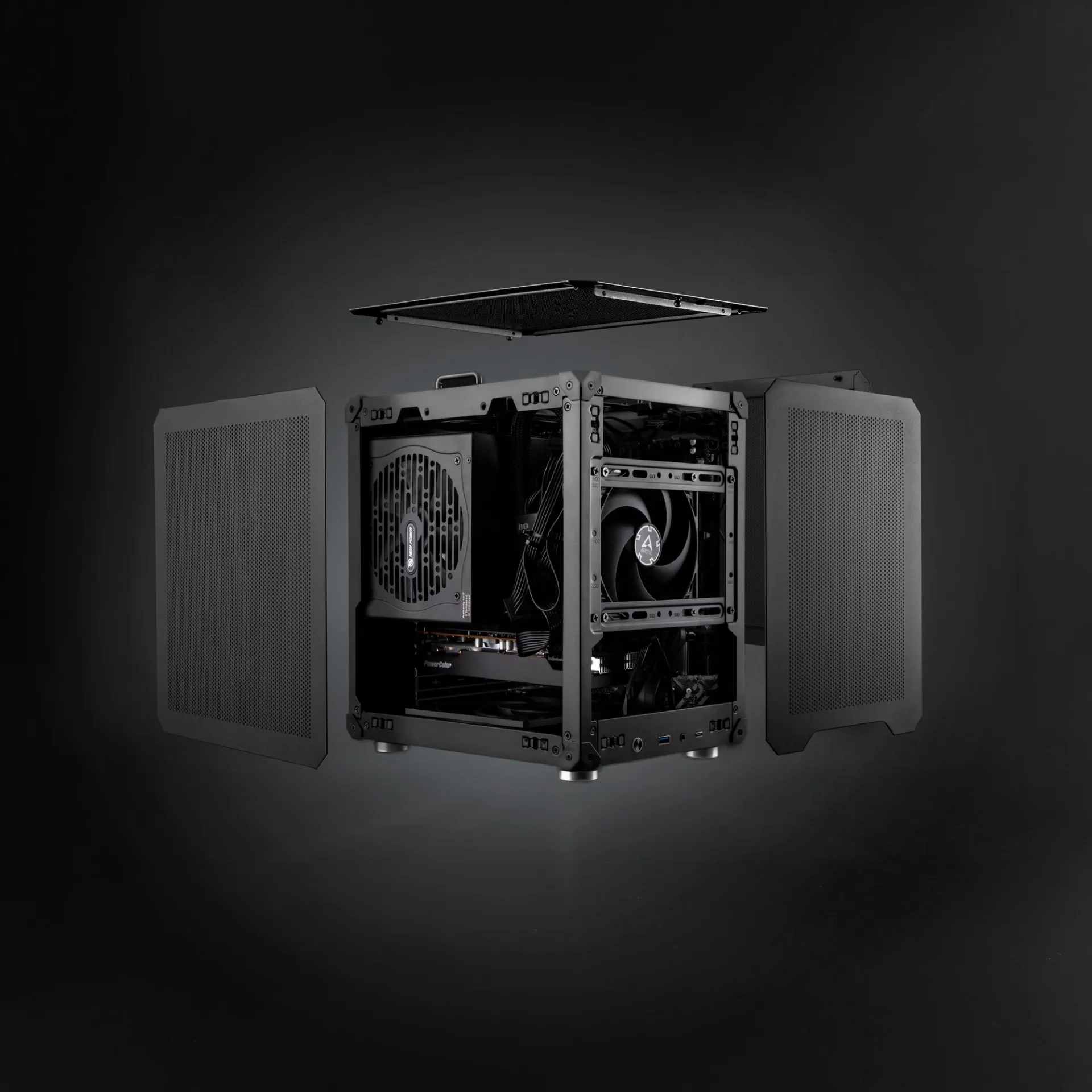
A low-profile cooler can run a stock 7600X, but the chip climbs to its temperature limit and the fans spin up hard to hold it there. In a quiet living room, that fan noise is easy to hear.
Stock X chips run hot
The 7600X and 7700X ship with a 105 W TDP, which allows up to 142 W of package power (PPT). They boost until they reach that power limit or their temperature limit, and with a small cooler, temperature usually comes first.
TechSpot tested a stock 7600X on AMD's small Wraith Spire box cooler. It hit 101 °C in Cinebench R23 and scored 5% lower than the same chip on a 360 mm liquid cooler. With Eco Mode on and the same box cooler, the peak dropped by about 7 °C. (TechSpot, Oct 2022)
Eco Mode means 88 W
The name suggests a hard 65 W cap. AMD's 65 W setting sets the package power limit to 88 W, with current limits of 75 A (TDC) and 150 A (EDC). Stock is 142 W, 110 A and 170 A. (PCWorld)
ASCII.jp measured a stock 7600X peaking at 101.9 W, well under its 142 W allowance, so an 88 W limit only trims the top of the curve. All-core work like rendering and compiling lives up there.
Benchmarks at four power limits
ComputerBase ran both chips at four package power limits. Cinebench R23 multi-core:
- Ryzen 5 7600X: 15,426 points at stock, 15,432 at Eco Mode's 88 W (no loss), 14,573 with a 65 W cap (5.5% lower) and 12,710 at 45 W (17.6% lower).
- Ryzen 7 7700X: 20,437 at stock, 19,700 at 88 W (3.6% lower), 18,080 at 65 W (11.5% lower) and 15,167 at 45 W (25.8% lower).
Single-core scores barely moved at any of those limits. (ComputerBase, Jan 2023)
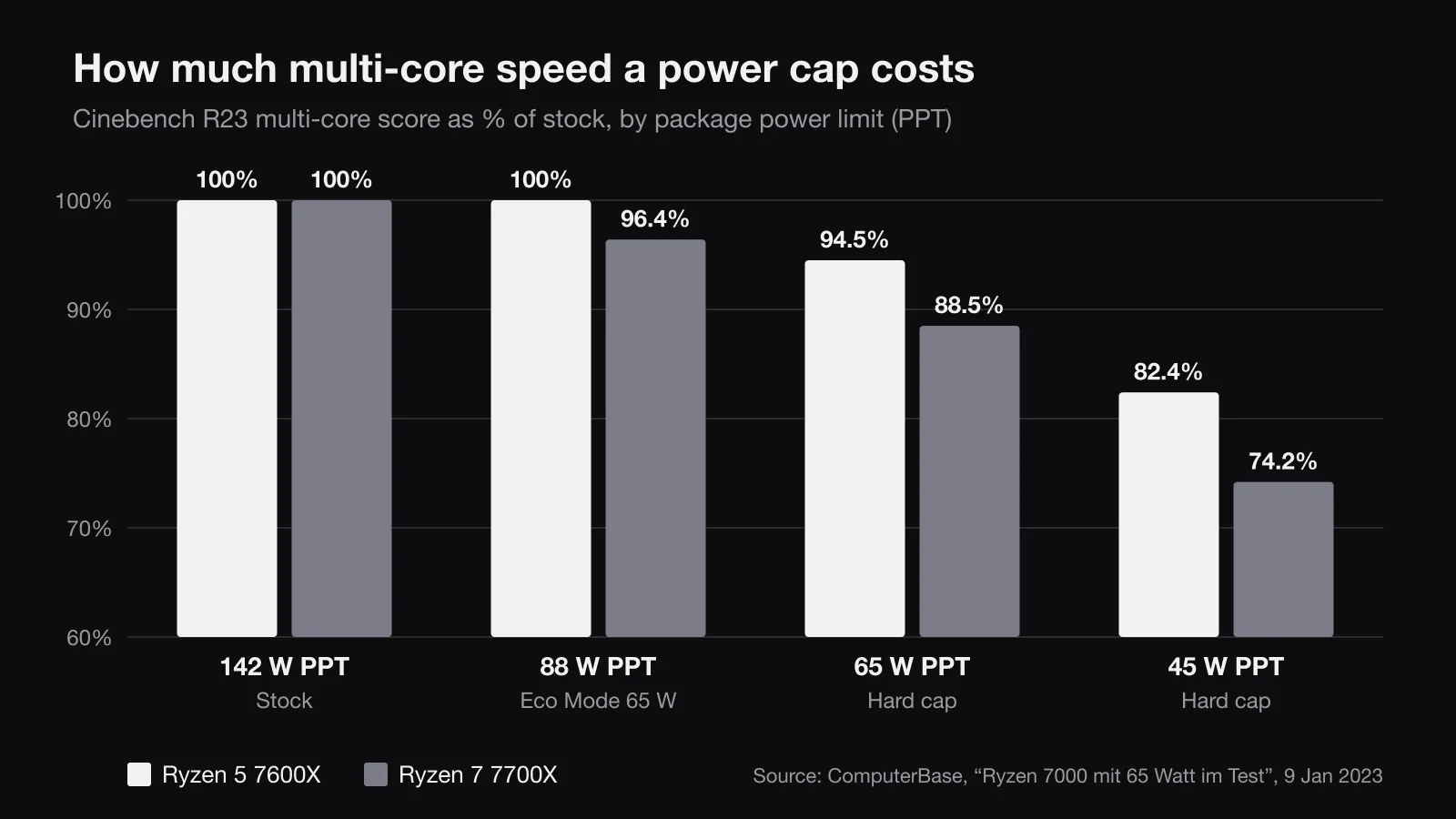
The 7700X has two more cores to feed, so a power cap bites it sooner. Under Eco Mode it still loses less than 4%.
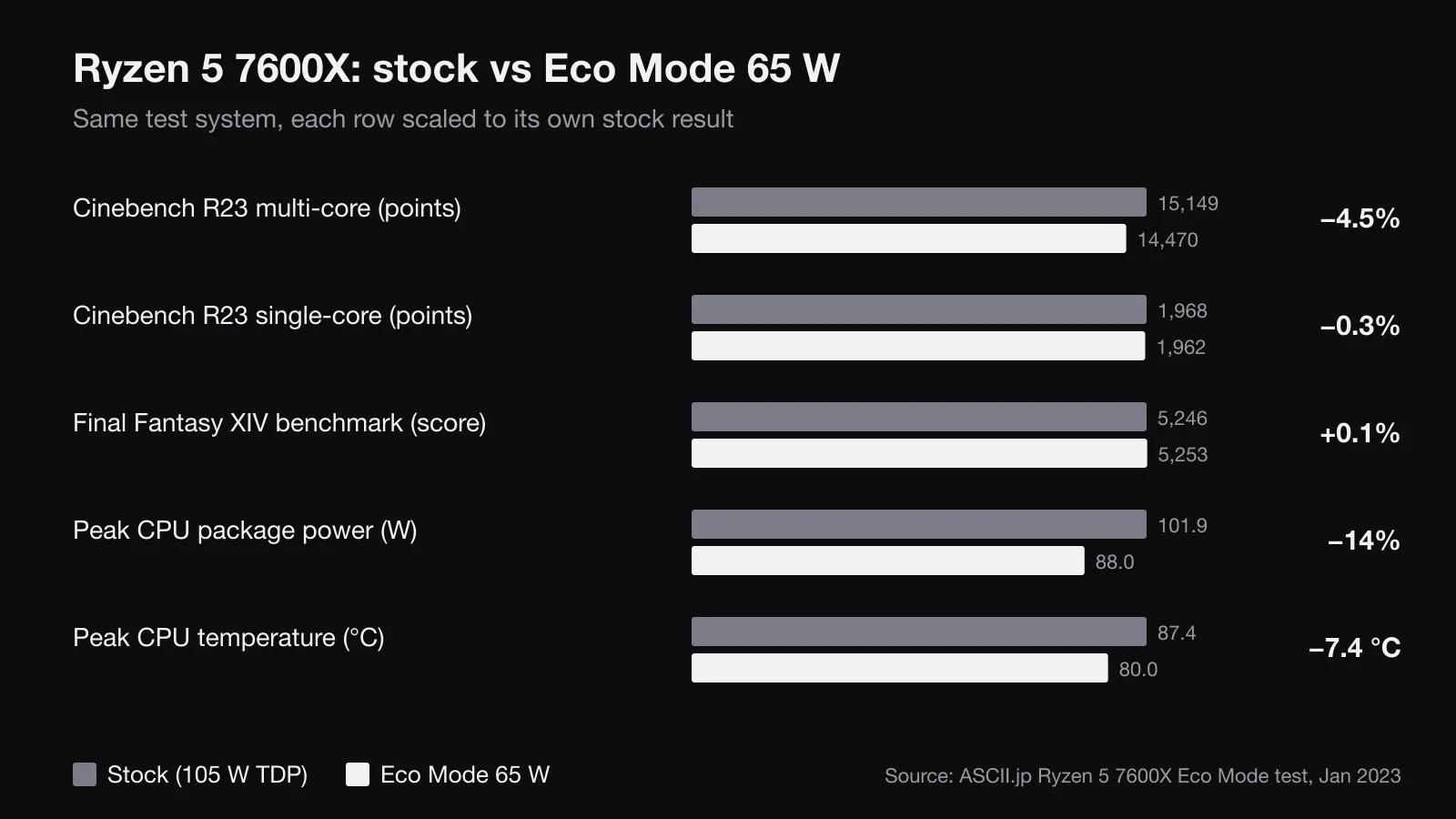
ASCII.jp's own 7600X run showed the same pattern: 4.5% lower in Cinebench multi-core, the same single-core and Final Fantasy XIV scores, peak package power down from 101.9 W to 88 W and peak temperature down from 87.4 °C to 80 °C. (ASCII.jp, Jan 2023)
TechSpot found gaming results "basically identical" between stock and Eco Mode across the games it ran. (TechSpot)
Turning it on
You can switch it on in two places:
- Ryzen Master (Windows): pick the Eco profile and apply it. This is AMD's one-click route.
- BIOS: most AM5 boards put an ECO Mode option under AMD Overclocking or Precision Boost Overdrive, where you choose the 65 W TDP setting. Menu names vary by board. Some boards only offer manual limits; there you enter 88 W PPT, 75 A TDC and 150 A EDC.
Ryzen Master is Windows-only, so on SteamOS use the BIOS, where the manual limits sit in the PBO menu. AMD's Ryzen Master page warns that settings outside AMD's specifications can void your warranty. Eco Mode lowers the limits. If you're unsure how your board handles it, ask the board maker.
After a reboot, run a game you know and a multi-core test. Peak temperature and package power should drop, with frame rates in the same range.
Turn on Eco Mode
On a Raster Zero with a Ryzen 5 7600X, we recommend turning on AMD's 65 W Eco Mode in the BIOS. Our SFF thermals guide covers the rest of the cooling plan. In a living room, quieter fans count for more than the last few percent in Cinebench.
A 7700X takes the same setting. Expect a slightly bigger multi-core loss than the 7600X in all-core work, and the same result in games. For the least heat with no tuning at all, a 65 W chip like the Ryzen 5 7600 or the 7500X3D is the other route.
Cooler and Eco Mode questions
Will a tower cooler fit?
No. Jonsbo lists a 75 mm limit for the C6. We use the 57 mm ID-Cooling IS-55, which leaves clearance above its 120 mm fan.
Is Eco Mode a 65 W cap?
No. It sets the package power limit to 88 W. At that limit ComputerBase measured no Cinebench multi-core loss on a 7600X and 3.6% on a 7700X.
Does Eco Mode hurt gaming?
Barely. TechSpot found results basically identical to stock, and ASCII.jp's Final Fantasy XIV score on a 7600X didn't drop.
Is a 7700X too hot?
Not with a sensible power limit. In Eco Mode it lost 3.6% of multi-core speed in ComputerBase's test. A harder 65 W package cap cost it 11.5%.
Sources
Last verified October 12, 2026.
- Jonsbo C6 product page (cooler height limit): jonsbo.com
- ID-Cooling IS-55 product page (height, fan, noise): idcooling.com
- ComputerBase, "Ryzen 7000 mit 65 Watt im Test", January 9, 2023 (Cinebench at 142/88/65/45 W)
- ASCII.jp, Ryzen 5 7600X Eco Mode test, January 2023 (stock vs Eco, power, temperature, FFXIV)
- TechSpot, "Is AMD Zen 4 Too Hot for a Box Cooler? Ryzen 7600X + Wraith Spire Tested", October 7, 2022
- PCWorld, "How to enable Eco Mode with Ryzen 7000", October 17, 2022 (PPT/TDC/EDC values)
- AMD Ryzen Master product page (warranty note)